Seeing the wood through the trees.
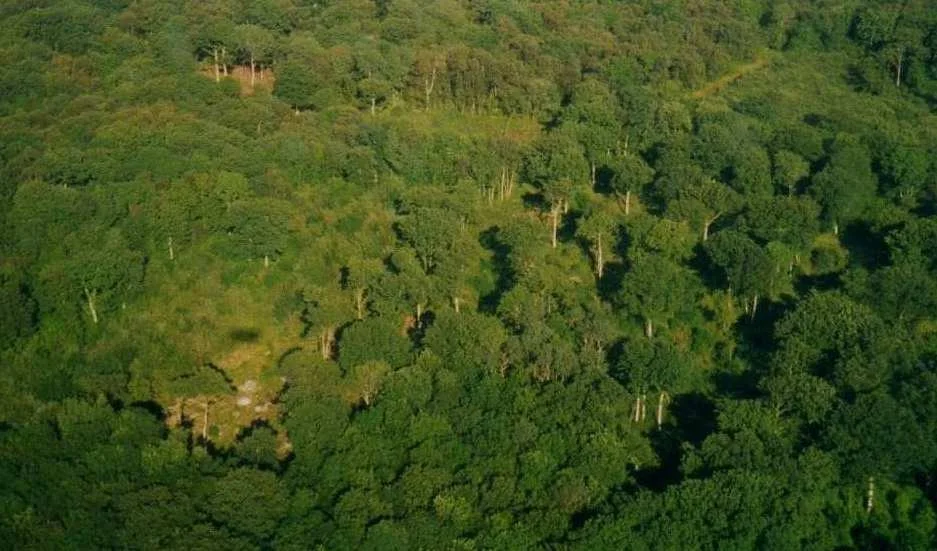
I’d like to tell you about this aerial photograph (below) of a nature reserve where I used to work. The photo perfectly illustrates a struggle common to us all, including me. That of being overwhelmed by our own emotions. Sometimes it seems impossible to find the space to process our feelings; to find a balance between wanting to feel calm and needing to find a way through. This balance can be found by creating space.
Emotionally intense situations can seem less overwhelming when you can distance yourself from them. This provides the space needed to see the bigger picture. So, rather than being lost in the woods, you can see a way to move between the gaps in the trees. To create such space in our thoughts and feelings, it sometimes only takes the power of speech and someone to listen. With such a perspective, it becomes easier to return and find one’s way through times of distress.
Returning to situations and experiences is part of the therapeutic process. Another part is connecting this past to the present. Both of these aspects of therapy can be hard emotional work. When looking at a tree, the past and present are visible by its shape and colour. However, people’s past and present are not so easily found; often least of all by the people themselves.
Like other biological systems and individuals, we humans are resilient and adaptable. Though we can easily forget this by becoming lost in the shade of negative emotions. My aim is to provide the space to help restore the ability to cope and rediscover your natural resilience.
Movement is medicine
Does it help to manage your emotions through regular exercise? Perhaps exhausting yourself is not quite your language, but any combination of breathing and stretching will do. I like swimming or just going for a walk and find these good remedies for a busy mind. Throughout prehistory, we humans have exercised our bodies more than our brains but nowadays its the other way round. Compared with our prehistoric ancestors, we all think more and exercise less. Here are some thoughts on the value of movement.
Our thoughts and emotions move each other. In our natural world, motion is inevitable: plants grow toward the light, temperature changes create wind, water moves between sea, air and land. In our internal world of emotions, motion is also inevitable; our brain processes our physical and emotional experiences, reacts with different chemicals and influences (sometimes overuling) thoughts about our next move. This next move could be combination of ‘regulated’ calm or ‘dysregulated’ distress responses. Such emotional movement becomes our medicine – designed to protect us.
As you may have experienced, exercise gives our brain a break. From operating in the past and the future, it enables us to focus on the present: sensing our heart beating, muscles working and regular breathing re-establishes communication between the body and the brain. The brain then responds by sending chemical messages to take the edge off our negative thoughts and emotions. Such natural chemicals, such as dopamine and serotonin, move us towards feelings of pleasure, calm and focus.
Although we may move alone, physically or emotionally, there are times when we need company. Over thousands of years, we humans have depended on our communication skills; during hunting and eating or dancing and painting. No surprise then that we are much better adapted to physical movement and communicating that we are sitting at a desk. All the more reason to seek company when we need it, to gain perspective on what we think and feel.